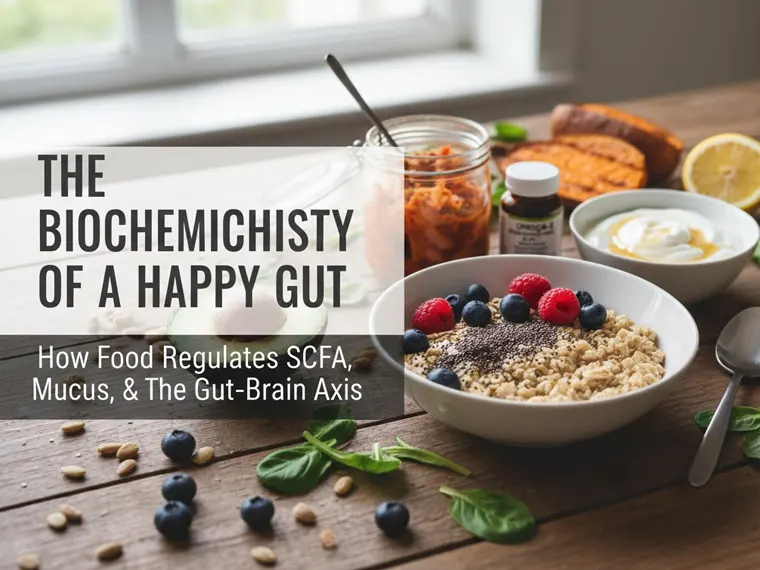
Food is the ultimate pharmacy for managing gut health and mood. Use biochemical knowledge to build your “Happy Gut.”
The gut is not just a digestive organ; it is the body’s second brain and the control center for mood. This state is known as the “Happy Gut,” and its efficiency and comfort entirely depend on the biochemical reactions triggered by the food we consume. True Gut Health Food Science goes beyond simply “eating more vegetables“; it focuses on how food precisely regulates the production of Short-Chain Fatty Acids (SCFA), the thickness of the Mucus Layer, and communication along the Gut-Brain Axis.
Today, we will deeply analyze how macronutrients and specific molecules in food affect your gut ecological system at the molecular level, ultimately determining your physical health and psychological state.
The Foundation of Gut Food: Macronutrients and Breakdown
The body employs different digestive strategies for various macronutrients, which directly impact the gut ecosystem.
Protein: Providing Amino Acids to Support Cell Renewal
- Building Blocks: The amino acids resulting from protein breakdown are the crucial building blocks for repairing and maintaining the gut lining cells (enterocytes).
- Repair Action: Specifically, Glutamine is one of the primary energy sources for gut cells and is essential for promoting Cell Renewal and repairing the damaged gut barrier. Adequate intake of quality protein is a prerequisite for maintaining gut barrier integrity.
Fat: Regulatory Role of Healthy Fatty Acids (e.g., Omega-3) on Inflammation
- Anti-Inflammatory Action: Healthy fats, especially Omega-3 fatty acids (such as EPA and DHA), exert powerful anti-inflammatory effects in the gut. They can regulate cell membrane fluidity and serve as precursors to generate anti-inflammatory mediators.
- Balancing Inflammation: By lowering levels of chronic inflammation, Omega-3 helps reduce continuous damage to the gut barrier, indirectly supporting Gut Health.
Carbohydrates: Distinguishing Digestible from Indigestible Fiber
- Digestible Carbohydrates: Most are broken down and absorbed in the small intestine, providing energy.
- Indigestible Fiber (Dietary Fiber): These pass into the large intestine, becoming the main source of prebiotics. Only these indigestible fibers can be fermented by the gut microbiome to produce SCFA. This is the core of Gut Health Food Science.
Core Mechanism 1: Prebiotic Foods and Short-Chain Fatty Acids (SCFA)
SCFA are the most crucial biochemical messengers between the gut microbiome and the host (the human body).
Butyrate Production: Which Foods Convert Most Efficiently to Butyrate
- Importance of Butyrate: Butyrate is the most vital SCFA for gut health. It is the primary energy source for colon cells (colonocytes) and is essential for maintaining Tight Junctions.
- High-Efficiency Conversion Foods: The most efficient prebiotic foods for producing Butyrate include Resistant Starch (e.g., cooked and cooled rice, potatoes), inulin (e.g., chicory root, onions, garlic), and $\beta$-glucans from oat bran. These foods are the “fuel” for building a Happy Gut.
The Dual Role of SCFA: Nourishing Colon Cells and Regulating Systemic Immunity
- Nourishing Cells: SCFA directly nourish colon cells by providing energy, strengthening the gut barrier.
- Immune Regulation: SCFA act not only in the gut but can also enter the bloodstream to regulate systemic immune responses. They promote the production of regulatory T cells (Tregs) and inhibit excessive inflammation, thus positively influencing conditions like asthma, allergies, and autoimmune diseases.
Core Mechanism 2: Food Maintenance of the Gut Barrier
Food not only nourishes cells but also provides physical protection and structural materials.
Mucus Layer: How Dietary Fiber and Tryptophan Affect Mucus Production and Thickness
- Physical Barrier: The Mucus Layer is a gel-like protective layer over the gut lining cells, serving as the first line of defense against direct contact between bacteria/toxins and the intestinal wall cells.
- Food Support:
- Dietary Fiber: The SCFA produced from the fermentation of certain dietary fibers can stimulate mucus-secreting cells (Goblet Cells) to generate thicker, healthier mucus.
- Tryptophan: This amino acid is a precursor to serotonin and has also been found to be crucial for maintaining the thickness and function of a healthy mucus layer.
Tight Junctions: The Contribution of Glutamine and Zinc to Repairing Leaky Gut
- Structural Defect: Tight Junctions are the “seals” connecting gut cells. When damaged, they lead to “Leaky Gut.”
- Repair Nutrients: Glutamine is the most critical nutrient for repairing damaged gut cells. Zinc is a co-factor essential for maintaining and rebuilding the structural stability and function of Tight Junctions. Supplementing these key nutrients is a scientific strategy for actively repairing the gut barrier.
Core Mechanism 3: Regulating the Gut-Brain Axis Through Diet
The biochemical communication of the Gut-Brain Axis is bidirectional, and food is the primary regulator.
Fermented Foods and the Production of Neurotransmitters like GABA
- Microbial Factory: The gut microbiome is a huge neurotransmitter factory. It can metabolize food components to produce chemical signals that affect the brain.
- GABA Production: For example, certain probiotic strains (commonly found in fermented foods like sauerkraut, kimchi, and yogurt) have been shown to synthesize GABA ($\gamma$-Aminobutyric Acid)—a major inhibitory neurotransmitter that helps reduce anxiety and promote relaxation.
Food Sensitivity: How to Use Exclusion to Identify Foods with Negative Emotional Impact
- Inflammation and Mood: For some individuals, food sensitivity (not true allergy) can trigger low-grade systemic inflammation. This inflammatory signal is transmitted to the brain via the Gut-Brain Axis, potentially leading to low mood, irritability, or “brain fog.”
- Elimination Diet: A scientific Elimination Diet can help identify foods that may negatively impact your mood and digestion, thereby cutting off the “unhappy” biochemical signals.
A Systemic Approach to Maintaining a Gut “Harmony Environment”
Maintaining Gut Health is a systemic effort combining the clearance of obstacles with nourishment and repair.
Integrating Fiber and Probiotics: Maximizing SCFA Production
- Golden Combination: The optimal strategy for maintaining a Happy Gut is to integrate prebiotic fiber (providing raw material for Butyrate) with probiotics (providing the fermentation factory). This integration maximizes SCFA production efficiency.
Clearance and Balance: Achieving Deep Cleansing and Environmental Reset on a Foundation of Scientific Diet
Before starting any SCFA nourishment or barrier repair diet, the gut environment must first be cleared.
- Clearing Obstacles: The So Easy 3-Day Colon Cleanse offers a scientific protocol for deep reset. It uses high-efficiency fiber like Oil Palm Fiber to gently clear the Impacted Fecal Matter and toxins accumulated in the colon. Only by clearing these obstacles can prebiotic foods and repair nutrients (like Glutamine, Zinc) be effectively absorbed and act upon gut cells.
- Repair Initiation: The So Easy protocol also integrates nutrients that support Cell Repair (such as amino acids from Wheatgrass), creating a clean, high-absorption initiation environment for subsequent SCFA production maximization and Mucus Layer repair.
Conclusion: Food is the Ultimate Pharmacy for Managing Gut Health and Mood
The biochemistry of a Happy Gut is complex, but the path to managing it is clear: scientific food choices.
By understanding the molecular needs of SCFA, the Mucus Layer, and Tight Junctions, you have mastered:
- How to use protein and zinc to repair the gut barrier.
- How to use Resistant Starch and Omega-3 to nourish cells and regulate inflammation.
- How to use fermented foods to balance the Gut-Brain Axis and improve mood.
Next Steps for Practice and Insight
Have you started viewing food as the “pharmacy” that regulates your mood and vitality?
We encourage you to:
- Increase foods rich in Resistant Starch and Butyrate precursors, such as overnight oats or cooled potatoes.
- Pay attention to your Omega-3 intake to support anti-inflammatory effects.
- Consider: Before you embark on nourishment and repair, does your gut need a deep cleansing reset to clear the accumulated waste that obstructs nutrient absorption and toxin excretion?
Build your Happy Gut with scientific food! Explore the So Easy 3-Day Colon Cleanse to provide a clean, efficient starting point for your gut nourishment and repair journey.