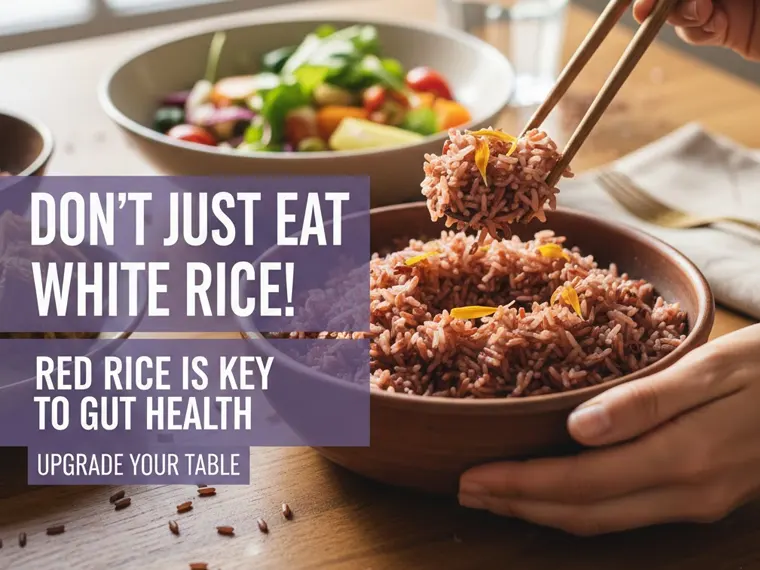
Upgrade Your Table. Red Rice is more than just a staple; it’s crucial for ensuring gut health and stable blood sugar.
In Asian dietary culture, rice is an indispensable energy source. However, the white rice commonly chosen by most people has lost its most valuable nutritional value during the refining process. This one-sided understanding of “healthy staples” is the root cause of many people facing blood sugar fluctuations, digestive sluggishness, and nutrient deficiencies.
We will focus on an overlooked “super staple“—Red Rice for Gut Health. It is not just a powerful source of fiber but a treasure trove of antioxidants and prebiotics. Today, we will expose four common misconceptions about Red Rice and use scientific evidence to prove that replacing white rice with Red Rice is a critical upgrade for achieving deep gut health and metabolic balance.
Misconception #1: Believing All “Rice” Has the Same Nutritional Value
The belief that the nutritional value of all rice is roughly the same is a misconception that severely underestimates the power of whole grains.
The Difference in Glycemic Index: How Red Rice Releases Energy More Stably
- White Rice: Classified as a high Glycemic Index (GI) food. The carbohydrates in refined white rice are rapidly broken down into glucose, leading to a quick post-meal blood sugar spike, followed by a large insulin release, which then causes a rapid drop in blood sugar. This fluctuation is detrimental to metabolic health and sustained energy.
- Red Rice: Classified as a medium-to-low GI food. The intact bran layer of Red Rice slows the action of digestive enzymes, allowing glucose to be released slowly and steadily into the bloodstream. This stable release is key to maintaining all-day energy and avoiding Insulin Resistance.
The Value of Bran and Germ: Key Vitamins and Minerals Lost in White Rice
During the refining process, white rice is stripped of its bran and germ—the most nutrient-dense parts.
- Red Rice Advantage: Red Rice retains the complete bran and germ, making it rich in B Vitamins (especially B1, B3, and B6), which are essential co-factors for energy metabolism and nervous system function.
- Mineral Treasure Trove: Red Rice also provides abundant minerals like magnesium, phosphorus, and zinc, which play important roles in supporting enzyme activity and immune function.
Misconception #2: Focusing Only on Fiber, Ignoring Red Rice’s Antioxidant Capacity
Although Red Rice is renowned for its high fiber content, its true superpower comes from its unique red pigment.
The Power of Red Pigment: Anthocyanins‘ Protective Effect on Gut Inflammation
The color of Red Rice primarily comes from Anthocyanins, a powerful class of polyphenol antioxidants.
- Anti-Inflammatory Mechanism: Anthocyanins are scientifically recognized for their potent anti-inflammatory effects. They neutralize free radicals and inhibit inflammatory signaling pathways, thereby reducing gut inflammation.
- Protective Role: Chronic gut inflammation is a driving force behind many digestive system disorders (such as IBS). The consumption of Red Rice provides a natural, anti-inflammatory protective layer for the gut.
Protecting the Gut Lining: How Antioxidants Support Gut Barrier Integrity
Gut Barrier Integrity is the critical line of defense against toxins leaking into the bloodstream.
- Cellular Damage: Oxidative stress (excessive free radicals) can damage the cells and tight junctions of the gut lining.
- Antioxidant Support: The abundant antioxidants in Red Rice protect these cells from damage, helping to maintain and repair the gut barrier. A strong gut barrier is a prerequisite for achieving deep gut health.
Misconception #3: Believing Red Rice is Harder to Digest or Causes Bloating
Many people avoid Red Rice because they believe all coarse staples cause bloating or indigestion. This fear often stems from incorrect cooking methods or an existing gut imbalance.
Prebiotic Properties: How Resistant Starch in Red Rice Gently Nourishes Probiotics
Red Rice contains a significant amount of Resistant Starch, a special type of carbohydrate.
- Digestive Characteristic: Resistant Starch is “resistant” because it escapes digestion in the small intestine, passing directly into the large intestine, where it is fermented by the gut microbiome.
- Prebiotic Function: Resistant Starch is a highly efficient prebiotic, gently and steadily nourishing probiotics and promoting the beneficial production of Short-Chain Fatty Acids (SCFA), which are vital for gut health.
Proper Cooking: Key Techniques for Reducing Phytic Acid and Enhancing Digestion
Red Rice does contain phytic acid, which can interfere with mineral absorption. However, this can be addressed through simple cooking techniques.
- Key Technique: Soaking the Red Rice for an extended period before cooking (at least 4–8 hours) can significantly reduce phytic acid content, making the Red Rice easier to digest and improving the bioavailability of its minerals.
- Adaptation: For those trying Red Rice for the first time, start with a small amount mixed with white rice and gradually transition, giving the gut microbiome time to adapt to this new source of prebiotics.
Misconception #4: Ignoring Red Rice’s Impact on Colon Clearing and Bowel Regularity
Red Rice plays an indispensable physical role in achieving Regular Bowel Movement and deep colon clearing.
The Mechanical Action of Coarse Fiber: Helping to Clear Impacted Fecal Matter
The bran layer of Red Rice provides a large amount of Insoluble Coarse Fiber.
- “Push” Effect: This coarse fiber creates “bulk” in the digestive tract, increasing mechanical stimulation of the intestinal wall, thereby effectively promoting gut peristalsis.
- Clearing Action: This powerful mechanical action is an important natural push that helps the gut clear Impacted Fecal Matter and residual waste, which is crucial for preventing chronic constipation.
Promoting Peristalsis: Natural Food Support for Regular Bowel Movement
Regular Bowel Movement is not only a sign of health but also a guarantee of effective detoxification.
- Scientific Basis: Through the dual action of bulk (Insoluble Fiber) and lubrication (Soluble Fiber), Red Rice allows the stool to form an ideal state—sufficient volume, soft, and moist—thus supporting Regular Bowel Movement and ensuring that toxins processed by the liver are excreted in a timely manner.
The Deep Gut Cleansing Strategy Beyond Staples
Red Rice for Gut Health is an excellent daily maintenance tool for achieving gut health, but it cannot deeply reset a colon that has accumulated Impacted Fecal Matter and is functionally sluggish for years. When facing chronic constipation, bloating, and metabolic sluggishness, a more integrated cleansing system is needed.
From “Daily Maintenance” to “Deep Reset“: High-Efficiency Support from an Integrated Cleansing System
Red Rice is a daily “booster,” while the So Easy 3-Day Colon Cleanse is the scientific tool for “deep reset.”
- Positioning: The precise fiber formula provided by So Easy is designed to gently and thoroughly clear Impacted Fecal Matter within 72 hours, recalibrating gut peristalsis and the microbial environment.
- Complementarity: This creates a “clean foundation” for the future intake of high-fiber staples like Red Rice. In a sluggish gut filled with waste and low absorption efficiency, even the nutrients in Red Rice cannot be effectively absorbed.
The Synergistic Effect of Red Rice and Precise Fiber Formulas: Maximizing Colon Cleanse Results
- Dual Guarantee: First, use So Easy for a deep reset to clear the exit and enhance the efficiency of gut absorption and excretion.
- Long-Term Maintenance: After the cleanse, use Red Rice as a daily staple, utilizing its high fiber and antioxidant properties to continuously nourish and maintain the newly established gut health environment. This “Reset + Maintenance” synergistic strategy is the optimal path to achieving long-term digestive wellness.
Conclusion: Upgrade Your Digestive Health with Red Rice
Red Rice for Gut Health is more than just a source of carbohydrates; it is a powerful combination of plant fiber, Anthocyanins, and Resistant Starch.
By correcting the misconceptions about the “white rice myth,” you now understand:
- Red Rice’s low GI characteristic is key to stable blood sugar and energy.
- Its Anthocyanins are an antioxidant shield protecting the gut lining and fighting inflammation.
- It provides Resistant Starch to gently nourish your gut microbiome.
Upgrading your daily diet with Red Rice is the simplest, most effective investment you can make in your digestive health and metabolic balance.
Are you ready to make Red Rice your healthy staple?
After reading this article, reflect: Does refined carbohydrate occupy too large a proportion of your current diet?
We encourage you to:
- Start incorporating Red Rice into your staple choices immediately, remembering the correct soaking and cooking techniques.
- Assess the “cleanliness” of your gut: If you suffer from chronic bloating and constipation, consider a scientific, deep colon reset.
Stop the “white rice myth” and start the Red Rice era. Learn more about how to achieve lasting, true gut health through scientific staple selection and precise cleansing systems!